Monday, December 19, 2011

lumpers and splitters


The number one question my college professors asked in class was “what is a species?” The predictable kids would shoot up their hands and explain that a species is a group of like organisms that can breed and produce viable, fertile offspring. And that is really not a bad answer. But there is no easy answer to this question.

I struggled for a long time to accept Linnaean taxonomy. That is- this system we have put in place to give animals Latin names to separate and organize them as much as humanly possible. We need it, for sure. It helps us organize evolutionary trees and distinguish one animal from another. But all of life is really on a grand continuum, and to me it almost seemed an insult to its complexity to try and finitely categorize all of its marvels.

After a few semesters of classes, I began to really get sick of how many species I was memorizing. But my feelings turned downright bitter when subspecies came into the picture. You’ve got to be kidding me, right? Can’t our scientific energy be directed to something more important?

I learned that those dirty scientists who insist on splitting groups of animals until there are at least a million species and subspecies per genus are called “splitters.” Those rational biologists who would like to clean up our present taxonomy by combining extremely similar animals are called “lumpers.” Until spring semester of senior year, I was a proud and unbudging lumper.

One of my best teachers of all time, Dr. Hill, devoted a class to talking about lumpers and splitters. He described to us what I just described to you. Someone raised their hand and asked whether he was a lumper or a splitter. After a brief pause, he said three horrible words. “I’m a splitter.” What? But I liked him. I liked a splitter? Gross.

Skip to the end of the lecture, and I don’t think it’s so gross anymore. As a bird biologist, he was acutely aware of the plummeting numbers of migratory songbirds. The more species of birds we have, the more birds the government can list as federally protected. Ahh. It was not an issue of organization at all. It was political. So much of science is driven by legislative politics. How had I never thought of it that way?

There’s something to be said for changing your mind. If it helps protect the birdies, I say to hell with a clean evolutionary tree. Split, people, split!

What do you think?

Monday, December 12, 2011

human to hope

Last year, I committed one of the deadly sins of scientific method. I said “I hope” in place of “I hypothesize.”

Let me set the stage. I am but a mere undergraduate, frightened and nervous to be presenting a research plan to a lab full of esteemed PhD and masters degree holders.  The lab meeting has gone surprisingly well- they have asked a lot of pointed questions, and none of them stumped me. After an hour or so of discussion, I’m feeling pretty confident and start speaking a little more freely. And then I say it…

“I hope to find significant variation within….”

I stop mid-sentence. I glance from face to face, slowly realizing what I had just done.

“I mean I hypothesize that I will find significant variation. I hypothesize. “

The damage had been done. The cardinal rule of scientific investigation: Experimenters must remain unbiased in order to obtain valid results. I know this; it has been drilled into my head relentlessly. What was I thinking?

After reflecting on my slip-up for the rest of the day, I realized that I knew exactly what I was thinking when I used the dreaded phrase. I was thinking how COOL it would be if I found that two salamanders species had evolved divergently so they didn’t compete with each other for food. That is remarkable. Somehow, the phrase “I hypothesize” just didn’t convey how cool this research question is.

I fully appreciate the necessity of indifference in scientific investigations. But come on people; it’s human to hope. Just don’t say it out loud- especially at a lab meeting.

Friday, December 2, 2011

coffee drinkers, this one goes out to you

Do you drink coffee? I myself am not so much a big coffee drinker, but I know lots of people are. If you consume even one cup of coffee a week, there is an indirect but very real way that you can help save wildlife. Please read on.

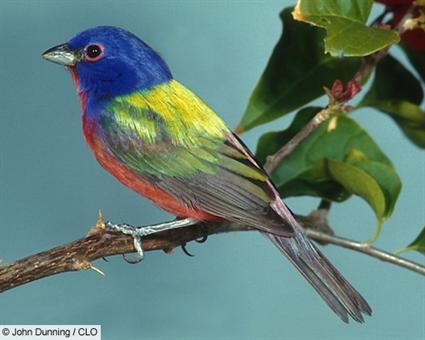
Songbirds (aka Passerines) are some of the most beloved animals we have in North America. They’re easy to find- look out of your window right now and I bet you’ll see at least one. Their songs make up the calming soundscapes of nature that people seek when they spend time outside. They’re oftentimes very beautiful. Here are some of my favorites-

Painted Bunting

Indigo Bunting

Black and White Warbler

There’s a whole subculture of birding enthusiasts across the country- it’s totally a thing. You’ll see them wandering around with binoculars, thousands of dollars worth of scopes and other optical equipment, and their trusty field guides in their packs. They will also likely have with them their “lifelist”- a list of all the birds of the continent with a little checkbox next to each bird for when said birder sees it. The satisfaction a birder feels when he or she checks a bird off his or her lifelist is comparable to seeing your favorite band play your favorite song live. Or eating a whole pan of brownies. Or whatever you find to be equally as gratifying.

One thing about many of the Passerines that makes them such a spectacle is their migratory habitats. Not all Passerines migrate, but many do. They head south in the fall to find food. Here in Alabama, the flocks of Cedar Waxwings are some of my favorites to look for in the winter. They come down from Canada for the winter and their soft wheezy calls make me think of cold winter mornings.

Cedar Waxwing

Many Passerines take it a step further and fly across the Gulf all the way to Central or South America. Here, they find shelter and food in the vast expanses of forests the tropics have to offer. For whatever reason, they especially like to roost in the trees of the large coffee plantations that stretch for miles and miles. The trees provide just the right amount of shade for the little coffee plants to be maximally productive, and apparently are just right for the migratory birdies too. A study done by the Smithsonian Migratory Bird Center found that shade-grown coffee plantations support a greater amount of migrant species than other lands devoted to agriculture. Win-win, right? Migrant birds habitat is protected and the coffee growers have good harvests that help to fuel their country’s struggling economy.

It was a win-win until recently. Coffee growers have started to plant another species of coffee plant that does not require the shade from trees overhead. Without the need for trees overhead to provide shade, planters mow down huge tracts of land to plant a greater amount of coffee. Problem is, migrant birds are still migrating… but to what? Their winter homes are disappearing. And consequently, so are they. Fast. So fast that your kids may not see but a fraction of the songbird diversity that you grew up with.

But can we really hate on the Central and South American coffee planters? I say no. They and their economies need the money, and the difference in profit between planting shade and sun coffee is huge. They’re doing what they must to support their families and economies. 


This is where we come in. As one of the largest consumers of Central and South American-grown coffee, America has the power to decrease the demand for sun coffee and increase the demand for shade coffee. And thanks to the Smithsonian Migratory Bird Center, it is easy. Next time you shop for coffee, look for this seal.

                                              
If the package bears this image, it means that the coffee inside has been grown and harvested from a certified shade coffee plantation. If you can’t find it at a local grocer, I encourage you to purchase your coffee online.

By making this small change, hundreds of species can be saved. Drink bird friendly coffee, save biodiversity!

I hope you will research this issue further. Google it up, folks. This is important.

Friday, November 25, 2011

a lucky bunch

Happy Thanksgiving. If you are participating in the Black Friday festivities, I hope you avoid being tased, pepper sprayed, punched, trampled, or any variety of associated violence. In keeping with the Thanksgiving spirit, I thought I would write a post about being thankful. This holiday season, let's all be thankful simply for our existence...

What was Charles Darwin’s primary contribution to science? If you answered “evolution,” slap yourself in the face.

Just kidding. Don’t. But truthfully, Charles Darwin did not come up with the idea of evolution. He explained it. He came up with natural selection. That was his major contribution to science.

People began to connect the fossil dots long before Darwin came along. In fact, there was sort of a natural history craze that was happening (especially in England. Gotta love those crazy Brits). They noticed that similar fossils seemed to gradually change over the strata. The evolution wheels had already started to turn in the years before Darwin. Naturalists unarguably recognized that species gradually changed over time, but had no foggy idea as to the mechanism that produced this gradual change.

Enter Charles Darwin. He proposed the idea that certain traits may give animals a survival and therefore reproductive advantage over others. These animals are statistically more likely to score and have babies. Those babies are then more likely to also carry the advantageous trait from their mom or dad (or both). And here is evolution on the smallest scale- a genetic change between generations. It carries on down the line until the changes become so drastic that a new species is born. This is speciation via natural selection.

Okay, to be honest, I just made it sound way simpler than it is. Not all traits that evolve are necessarily “selected for.” Sometimes they are random, sort of meaningless characteristics. Take human eye color, for instance. There are hazels, browns, blues, and greens. These colors evolved, certainly. But were they selected for? Did having blue eyes make somebody more likely to have fit offspring over brown eyed people? Probably not. Random, chance mutations caused these diverging eye colors. Not selective pressure.

There in lies a nuance of evolutionary theory that often goes overlooked. Evolution is not intelligent nor guided (sorry, pro-intelligent design homies). Nor is it a perfect process (queue dancing appendix here). Some things evolve purely by random chance, and natural selection acts upon only the traits that make a critter more likely to have fit offspring. All life is a result of the interaction between random chance and natural selection.

Eye color. Jellyfish. Strep throat. Poison ivy. You. These are all things that are here thanks in large part to chance. We earthlings are a lucky bunch, aren’t we?

Thursday, November 17, 2011

dna... or something like it

Hypothetical situation: you work as an official at NASA and the news comes in. Extraterrestrial life has been found and confirmed. What is the first thing that you want to know about it? Well, if it’s intelligent, it would be polite to ask if it is having a good day. Otherwise, I personally think the most interesting and important question would be “is it a DNA- based life form?”

DNA. What do you know about it? You probably know that it codes for our genes. It is unique to each species and each individual within that species. It’s a molecule that looks like a twisty staircase. You might even know what it stands for- deoxyribonucleic acid. And you would be right about all of this. These are the basics of DNA. But lets get our hands a little dirtier.


The “rails” of the twisty staircase are the structural foundation for DNA, but the steps of the staircase are what’s really important. There are four different kinds of “steps.” A step may be one of four molecular bases- adenine, guanine, cytocine, or thymine (commonly represented by A, G, C, T). A gene is made up of about 3000 bases, with A, G, C, and T appearing in different orders. The order in which the A, G, C, and T appear define the gene. Humans have about 30,000 genes. Do the math, and that’s a frickin ton of DNA. That’s not even counting the trash DNA that doesn’t code for genes- which is quite a lot.

And what makes it even more marvelous is that it is universal. All earthly life- from bacteria, to plants, to fungi, to sea sponges, to vertebrates- is DNA-based. Not only are they all DNA based, but the language in which the DNA is coded is the same across life. “ATTTGCCAGATTACAAT” codes for the same thing in a bacterium as it does in a rose bush, as it does in you. That’s why we can put the genes for human insulin into a bacterium and we get… well, human insulin.

Point is, DNA is a highly complex molecule whose processes are just as complex. The DNA system has been evolving since life began, making it one of the oldest and arguably most intricate biological coordinations of structure and function in existence. Earthly existence, that is…

Wouldn’t it be something to take a look at how an extraterrestrial life system works? Assuming that this extraterrestrial species reproduces and traits are inherited across generations, there must be some system by which these traits are inherited. It’s hard to think outside of the DNA box, but let’s try. Maybe they have genetic material that is arranged in something other than a double helix- like a sphere or something. Does it have a structural component and then the genetic message woven in like ours? Does it use similar molecules or ones that we’ve never even seen before? Is 100% of it functional, or are there portions that are trash and just left over from evolutionary past (let me refer you to the name of the blog here!)? The questions and possibilities are endless.

As remarkable as it would be to discover a completely new system of genetic inheritance, I can’t help but hope that it’s not all that different from our own. What a tribute it would be to our humble deoxyribonucleic acid to find that it is a product of the same evolutionary forces felt by lifesystems throughout the cosmos. It’s a romantic notion, really. I like the thought of being related to ET through a shared biomechanism that evolved multiple times, light years apart. It will truly make you feel “one with the universe.”

Unless these extraterrestrials are like the terrifying ones from Alien. Then I think I’ll keep my DNA queries to myself. But even then, it might still be worth being eaten to find out.


Wednesday, November 9, 2011

my humps, my humps, my lovely lady lumps

Although I usually post on Fridays, I will be on a research trip starting tomorrow and unable to write. And since I know you are all waiting breathlessly at your computers for a new post, I’m posting early so as not to cause anyone to plummet into depression.

Take a look at the cartoons below.


Above and to the left, we have a rendering of the original Arthur the Aardvark. Above and to the right, we have a rendering of the modern-day Arthur that we all know and love. What changed between the two? A sweater has been swapped for the dorky button down. No handkerchief. Glasses were added. Most noticeably, new Arthur is missing the elongated snout (which is pretty much the defining feature of a real aardvark’s head, might I add). But overall, if you had to sum it up, what is the big difference? Okay I’ll just tell you.

The new character is more round.  From the head, to the glasses, to his ears, to the lines of his shirt, his features are more rounded. And this is no happy coincidence. Why, you ask? Because old Arthur had really bad ratings until his creator figured out that the human mind is hard wired to respond positively to round shapes. Scheming cartoonists. And there’s another circular cartoon character that has been crafted to work his way into your heart by appealing to your basic animal affinity for curvature…


But when we’re talking about biologically relevant features as opposed to Mickey Mouse or Arthur the Aardvark, roundness plays a part in A.) parental care B.) male --> female attraction.

Babies are round. Ever notice that? From their button noses and big round eyes to their weirdly fat asses and limbs, the pudgy little creatures elicit feelings of protectiveness and affection from (most) adults. This is an evolved mechanism for increasing the level of care an offspring receives from its parents. This response is so primal that it even extends trans-species. I don’t know about you, but I get way more excited about little kittens and puppies than grown cats and dogs, respectively. Though you don’t consciously realize it, shape recognition is a basic feature of the animal brain and exists even in critters like insects and crustaceans.

Specifically, mammals’ shape recognition centers generally seem to activate at the site of roundness. When the optical shape recognition part of the brain senses curvature, a signal is sent to the amygdala (emotion center) and causes good feelings like affection, protectiveness, or attraction. This all happens subconsciously- we’re not even aware of it. It is hard wired in us. Especially males.

To see this in action, visit your local college bar. Girls have their boobs pushed up to their clavicles and are donning clothes that make their butts look maximally perky and round. Eyeliner and mascara help to create the illusion of big, round, bright eyes. Lip gloss helps to make lips look plump. Tight clothes accentuate the circular lines of the waist and hips. High heels help to flex the calf muscle and round out the lower leg. And these girls are spot on- they know (even if it is only subconsciously) what gets attention. It’s all beginning to make sense now…

One might even make the connection that this reaction is heightened in males to increase paternal fidelity. That is, the father feels a stronger connection to its round little babies and is more likely to help contribute parental care- making the offspring’s chance of survival better.

Do you feel like nothing more than a slave to your instincts? It’s okay. You can’t help it. They’re there for a reason.

Friday, November 4, 2011

baby mommas and baby daddys

This past summer, I lived by myself in a little house out in the middle of a cornfield in rural central Louisiana. A bunch of barn swallows decided it would be the perfect place to be the local hangout/nesting site. At first, I would sit on the porch and watch them, appreciating their pretty blue feathers, rusty bellies and elegant silhouettes against the sky. As the weeks went on, they would not shut the eff up and I took to throwing lit firecrackers at them. What? Don’t judge me.

One morning, as I was leaving for work, I seemed to piss them off more than usual. They began to dive-bomb me. Aggressively. I felt one’s tiny little feet graze my hair. They were not letting up. I looked back at the porch and saw what had set them off. A baby swallow had hopped out of the nest and onto the porch that morning and I had walked within a foot of it. My feelings of avecide faded and I understood. They were just doing what they were programmed to do- they look out for their babies just like we do.

Parental care is well-researched behavior, and, simply put, is the investment that a parent makes in its offspring. It is a behavior that varies greatly both between and within taxa. Some frogs lay their eggs and haul ass, never to see the shining faces of their froglets. Then you have frogs that carry their babies in pores on their very own backs to keep them safe. Even invertebrates (those soulless, unrelatable creatures like bugs) sometimes lay their eggs in another animal, so that when they hatch they’ll have something to eat. Even though mom doesn’t stick around, that is still a form of parental care.

If you go to Google Scholar and type in “parental care,” most of the papers that pop up will be studies about birds. Parental care is especially interesting in birds. Can you think of any reasons why? Contrast it with mammals. Mammal moms carry the fetus internally until birth and most times, dad hit it and quit it and he’s nowhere to be found. At the end of the day, it’s up to mom whether or not the offspring will be taken care of after birth. How is this process different in birds?

They lay eggs instead of getting knocked up. Fetal development happens outside of the female. Eggs and egg laying certainly take energy from the female, but it is drastically less of an investment than pregnancy. When human females experience a miscarriage, the loss is profound both emotionally, but also physically. This is just how it is for mammals. We (females) physically invest an enormous amount of energy and resources into our offspring. But how many times have you seen a bird abandon her nest for apparently no reason? It happens all the time. It’s nothing for a bird to find another willing mate and drop some more eggs.

So imagine you’re a male bird. A few days after sex, Tina (your current partner) lays some eggs and guess what. They’re 50% your problem. She can easily go find another guy bird who will mate with her and actually help rear the offspring. So you better get in gear and start helping out, or Tina will abandon your ass and your name will die with you.

With this system of external fetal development, there is more of an opportunity for males to contribute to their offspring’s chances of survival. The parental investment is more evenly balanced. Not a bad set-up, if you ask me.


Friday bonus:
In light of the recent exotic animal escape in Ohio, a friend of mine has posted his take on the situation. Great read. Check it out.


http://4-2morrow.blogspot.com/2011/10/learning-from-tragedy-call-to-crack.html